

With their squishy pink bodies, big shining eyes, and happy ‘smiles’, axolotls seem to be everywhere in popular culture these days. They are on social media, in toy stores and even in the video game Minecraft.
But despite being superstars of the salamander world they are quite rare in the natural world. The only location they can be found in the wild is in Lake Xochimilco in Mexico City, and even there they are seldom seen. Pollution, invasive species, and destruction of their natural habitat have devastated the axolotl population. It is estimated that there between 50-1000 adults left in the wild and the species is considered critically endangered!
The word axolotl comes from Nahuatl, the Indigenous Mexican language spoken by the Aztecs. They are named for the Aztec god Xolotl, who was said to transform into a salamander.
In the 1860s a French explorer brought 34 axolotls from Mexico City to Paris where scientists bred them. By the 1870s they could be found in all European countries. Most of the axolotls in captivity today are descended from those 34 traveling salamanders!
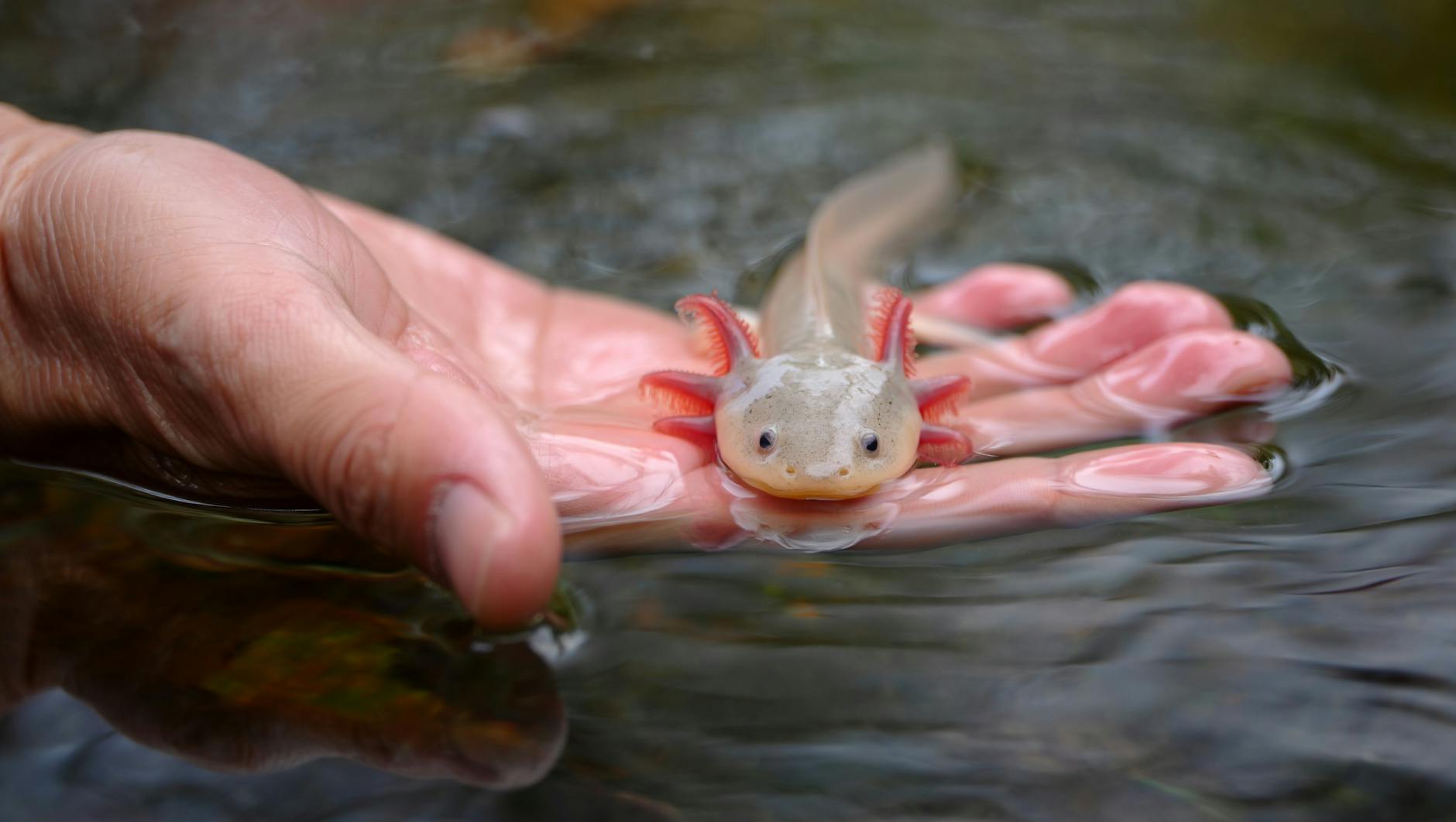
Like frogs, axolotls are amphibians, a class of animals that lay their eggs in water. Those eggs then hatch into water dwelling larvae (for frogs this is the tadpole stage). Once amphibians become adults, they should be able to move to land, staying close to water so they can absorb oxygen through moist skin. But not axolotls. They never complete the change and instead spend their whole lives in water.
Axolotls are neotenic, which means they keep juvenile characteristics like gills, tail and body fin into adulthood.
Axolotls in the wild are most likely to be green or brown. Pink, white, and blue variations are common to those bred in captivity. They can, however, change their colour to camouflage themselves from predators. When fully grown they measure from 20-25 centimetres, about the length of an envelope.
Axolotls will eat anything from worms to shellfish to insects and small fish. As they never develop teeth they crush and devour their meal with a powerful force of suction. And while they boast a large number of prey, they themselves are prey to a number of predators, large fish and swooping birds included.

The axolotl can reproduce as many as three times a year with the female laying up to 1,000 eggs each time.
One of the axolotl’s most distinct features are the ‘feathers’ that extend from their bodies. These are their gills, which help them breathe underwater. They also have lungs (one of the few creatures to have both gills and lungs) but they are not developed enough to allow the axolotl to survive more than a couple of hours on land.
One of the most fascinating qualities the axolotl possesses is its ability to regenerate or grow back parts of its body. Like some other species of salamanders, it can regrow missing limbs including feet and tails. It can even regrow organs. For this reason, scientists believe that the axolotl could hold the key to evolution and regeneration. If they can figure out how the axolotl does it they might be able to do the same with humans.
But the axolotl guards its biological secrets very closely. Its genome, the set of DNA instructions found in each of its cells, is ten time larger than a human’s, with over 32 billion individual DNA strands. This makes it a daunting task for any scientist looking to pinpoint what genes may be responsible for regeneration!
In some US States and Canadian Provinces axolotls are illegal to own or can only be owned with a special permit. This is because (like most species) they pose a serious threat to any environment they are not native to should they ever be released or escape into the wild.

 Sadie Science