
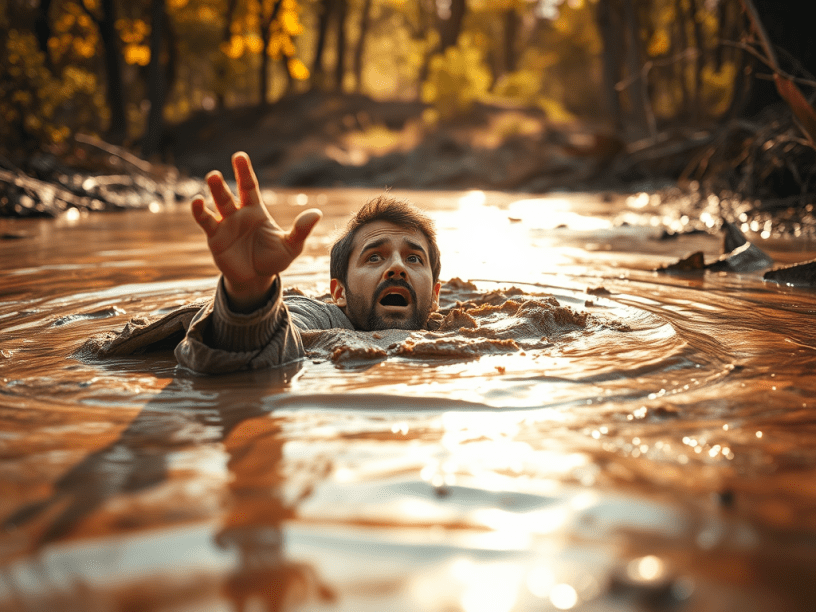
At first the ground feels solid beneath your feet, but you soon become aware of a sensation you may be sinking. You try to take a step, but you are unable to raise your foot out of the muck. The more you try to wriggle free the farther down you sink. First your feet, then your legs and soon you are up to your chest in the liquid earth. As the sludge rises to your chin, you wonder if this will be the end!
For years movie directors have used the perils of quicksand to put our heroines and heroes into danger. Indiana Jones, the Princess Bride and even the good guys of Star Wars have had to find ways to escape its clutches before being sucked down to their doom.
Quicksand appears in almost three percent of all the movies made in the 1960s. That’s about one in every 35!
What is quicksand and is it really that dangerous?
In its simplest terms quicksand is sand that is ‘floating’ in water. It is a combination of sand, mud, clay, or silt that is saturated with water to form what is known in chemistry as a colloid. Within colloids, one material (in this case sand) is suspended throughout another (in this case water) without it separating and sinking to the bottom. When undisturbed the solid particles in quicksand stay in one spot, and it often appears as stable surface. Very light objects such as leaves may settle on it, making it appear even more like the solid ground around it.
But agitate quicksand by stepping in it and its viscosity (how fast or slowly it will flow) decreases. Silt and sand sink to the bottom and water rises to the surface, making it act more liquid than solid, and unable to support weight.
Conditions must be perfect for quicksand to form. Marshes, beaches, the shores of lakes and the banks of rivers are all potential locations where you may come across it. It just needs the ideal consistency of soil and a steady source of water circulating underground.
The good news is that it is pretty much impossible to meet your doom in quicksand. The human body is about half the density of quicksand making it easier for you to float in quicksand than it is to float in water. And it is very likely a quicksand pit is not more than a few feet deep anyway!
Quicksand is a non-Newtonian fluid, which is a fluid that does not follow Newton’s law of viscosity. Ketchup is one too -once shaken it flows more quickly.
If you did find yourself stepping into deep quicksand the best thing to do is not panic. Drop any heavy items you are carrying such as a backpack, lie on your back and spread your arms and legs. A greater body surface will stop you from sinking. By slowly moving your legs you can churn up the sand to bring water to the surface which should make it easier to extract yourself from the muck.
Scientists have also produced dry quicksand where very fine particles of sand are suspended in air rather than water. There was concern during Apollo lunar missions that astronauts or equipment might be lost to dry quicksand on the moon.
 Sadie Science