
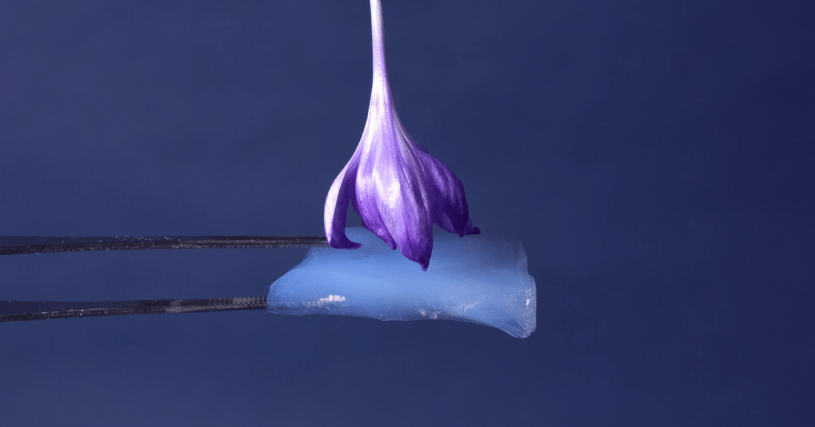
Imagine what would happen if you took the jiggle out of jelly?
In 1931 Dr. Samuel Stephens Kistler bet another scientist that he could remove all the liquid from a gel, in this case jelly, and replace it with gas and the jelly would remain the same shape. Kistler won that bet and the first aerogel was created.
A gel is a bit of an oddball as it is made up of mainly liquid but behaves like a solid. A cross-linking system within the fluid of the gel gives it structure and firmness. When liquid molecules are successfully removed, and gas molecules take their place, the gel remains solid and maintains its shape. It is now an aerogel!
Up to 99.98 per cent of the volume of an aerogel can be composed of air, making it the world’s lightest solid material. It is also incredibly strong, able to support 400 to 5000 times its weight. A block of aerogel as large as an adult could weigh less than a pound but still be able to support 1000 pounds of weight.
Extremely small air pockets within the aerogel’s structure mean that air and gas molecules can’t move about freely. This means that heat cannot spread easily throughout it making it an extremely effective insulator that can withstand very high temperatures. These same properties make it a great sound insulator as well.
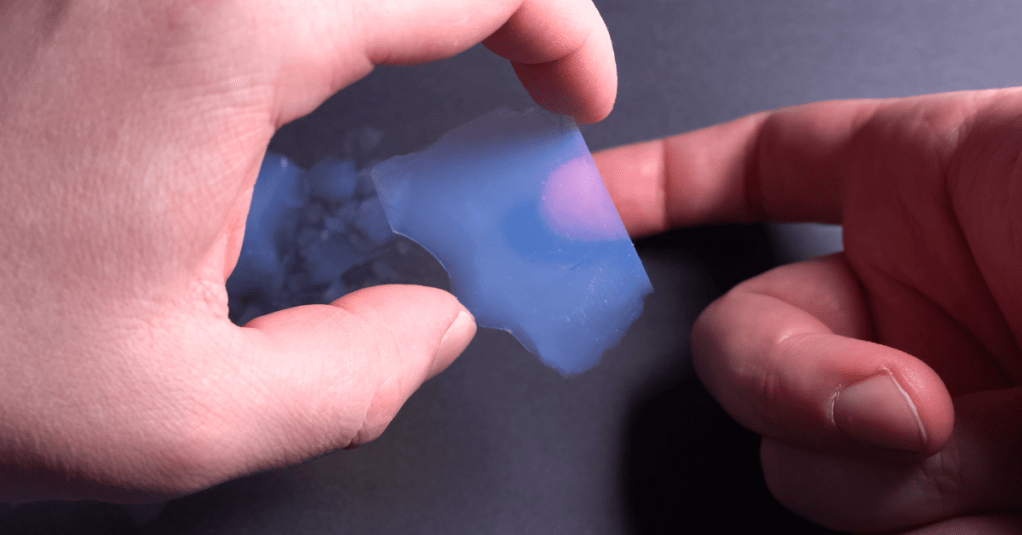
Today’s aerogels are mainly made from silica, a compound of the two most abundant elements in the earth’s crust, silicon and oxygen. Aerogel may be a super solid but it does have a weakness. If it has not been waterproofed it can be destroyed with a few drops of water.
Aerogel can cost tens of thousands of dollars per kilogram making it as expensive as gold.
Aerogels on Earth: Aerogels can be found in wetsuits, skylights, paints, cosmetics, rockets and protective clothing for firefighters.
Aerogels in space: NASA uses aerogels to insulate space suits and the Mars Rover as well as collect star dust from outer space.
When NASA scientists wanted to collect and study dust from comets, they faced a number of problems that only aerogel could solve. Dust particles from comets move at a speed about six times as a fast as a bullet shot from a gun. If scientists were simply to scoop up the dust the speed and heat from the impact would damage the particles. The solution was a pair of giant ‘tennis rackets’ made up a grid of aerogel cells that the dust could fly into. When the dust hit the aerogel, it slowed the particles down but kept them intact. Not only could scientists perfectly preserve the particles for study but they could also trace the path they left from the cone-shaped indentation in the aerogel.
Because of their appearance aerogels are sometimes referred to as frozen, solid or blue smoke. They have even been called pet clouds.
 Sadie Science